Oura el jbel – Behind the Mountains - Dietro le montagne Regista: Mohamed Ben Attia (Copia)

Oura el jbel – Behind the Mountains
Directed by Mohamed Ben Attia
Starring: Majd Mastoura, Walid Bouchhioua, Samer Bisharat, Selma Zghidi, Helmi Dridi, Wissem Belgharak, Ayoub Hedhili, Mondher Chouchen, Amel Karray, Ammar Chikha, Rania Agrebi
Countries: Tunisia, Belgium, France, Italy, Saudi Arabia, Qatar
Year: 2023
Author: Roberto Matteucci
Click Here for Italian Version
“You saw me fly, right?”
Flying has been a human chimaera since epic times, beginning with the story of Daedalus and Icarus.
Daedalus does not need much to rise into the sky: simply feathers and wax, both for himself and for his son Icarus. They are imprisoned in the labyrinth; they require wings to escape.
For Icarus, finding a way out is not enough; more awaits. It is a matter of adolescent hormones, madness, detachment from a very ever-present father, defying dangers, pride, curiosity, the desire to always surpass himself, and astonish others.
Icarus disregards his father's advice; indeed, he wants to defy it precisely because it is forbidden:
“He instructed the boy as well, saying ‘Let me warn you, Icarus, to take the middle way, in case the moisture weighs down your wings, if you fly too low, or if you go too high, the sun scorches them. Travel between the extremes. And I order you not to aim towards Bootes, the Herdsman, or Helice, the Great Bear, or towards the drawn sword of Orion: take the course I show you!’ “
...
“And now Samos, sacred to Juno, lay ahead to the left (Delos and Paros were behind them), Lebinthos, and Calymne, rich in honey, to the right, when the boy began to delight in his daring flight, and abandoning his guide, drawn by desire for the heavens, soared higher. His nearness to the devouring sun softened the fragrant wax that held the wings: and the wax melted: he flailed with bare arms, but losing his oar-like wings, could not ride the air. Even as his mouth was crying his father’s name, it vanished into the dark blue sea, the Icarian Sea, called after him.” (1)

Tunisia today is also a labyrinth: deep economic crisis, the need to secure a billion-dollar loan from the IMF, with the resulting draconian austerity measures imposed by the Fund. Furthermore:
"... the agency Fitch Ratings has downgraded the country's sovereign rating to 'CCC-,' indicating a high probability of default with minimal recovery prospects..." (2)
In truth, more painful reasons weigh on Tunisia. The deficit could be resolved—it is not a large loan—but it provokes more acute tensions. The tragic moment for Tunisia was the infamous Colour Revolution. Afterwards, Tunisia became the battleground between secularists led by Tunisian President Saïed and some Middle Eastern countries, financiers of an uprising to overthrow the country. According to international sources, the main problem:
"What has happened in recent months in Tunisia is part of a progressive erosion of the rule of law, political and civil liberties, a dynamic that has intensified particularly since the beginning of February [2023]. The closure of Ennahda's offices and the arrest of Ghannouchi on charges of conspiracy against the state... as well as his sentence in absentia to one year in prison for apology of terrorism in May..." (2)
It is not easy to escape this economic and political morass. To escape, a Tunisian must look at the sea or look to the sky.

Rafik, the protagonist of the film Oura el jbel – Behind the Mountains by Tunisian director Mohamed Ben Attia, reverses the myth of Daedalus and Icarus.
Rafik is divorced and has a son not yet a teenager, who lives with his mother. He wants to fly beyond the laws of gravity, even involving his son, who instead would run away. Rafik does not "take the middle way". He does not "in case the moisture weighs down your wings, if you fly too low, or if you go too high, the sun scorches them." Rafik and Icarus have the same result: "Even as his mouth was crying his father's name, it vanished into the dark blue sea, the Icarian Sea, called after him." (1)
The film was presented at the 80th Venice Film Festival, co-produced by Jean-Pierre and Luc Dardenne.
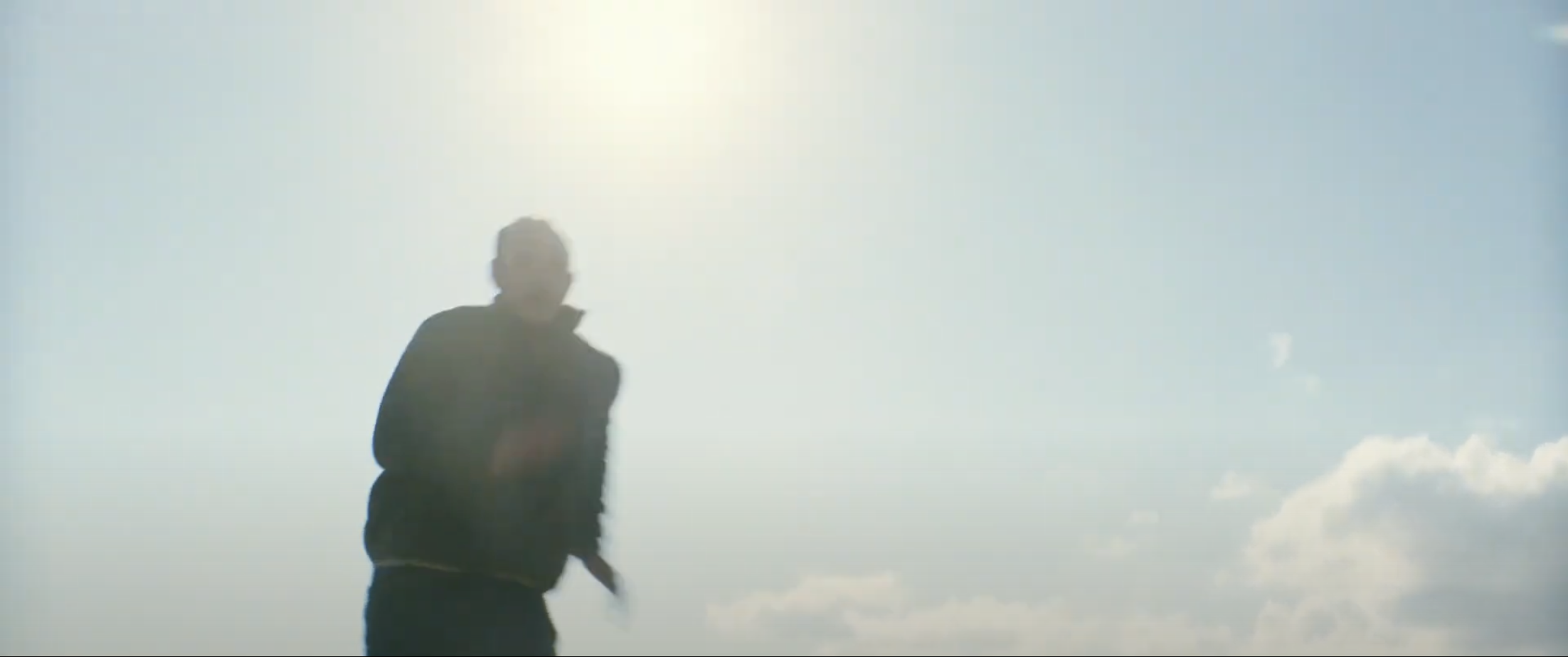
Rafik is urinating in the toilets of his workplace. Then, he enters his office crowded with colleagues. Rafik returns and begins smashing computers and desks. Calming down, he opens the window and jumps out. His intent is flight, not death. In prison, he tries to hover from the top of a building again. Is he mentally unstable? He remains locked up for four years. Upon his release, his wife rejects him, so he kidnaps their son, Yasine, from school.
With Yasine, he escapes to the countryside in northern Tunisia. It is a breathtaking mountainous landscape. Pursued by the police, he is forced to abandon his car and vanish into the woods. They finally find a modern, isolated villa, inhabited by a middle-class family. Threatening them, Rafik coerces his way into the house, managing to discover temporary refuge.

Mohamed Ben Attia employs vivid imagination to express his thoughts and channel them into the film: Tunisia and its turmoil, the allegory of human flight, relationships in contemporary society and the return of alienation, spirituality and secularism.
Tunisia, its fake revolution, foreign interference, social and financial unrest have caused personal and family distress. A description chosen by the filmmaker:
“I don’t know for the rest of the world, but in our country, since the 2011 revolution and mostly since the pandemic, psychologists and psychiatrists are overwhelmed by work. It reflects the social and individual discomfort I was mentioning before: our interrogations wormed their way up into our psyche. We are doing worse and worse. I’m not nostalgic for the past, but I can see there is a real existential crisis that goes beyond medical observation.” (3)
Rafik suffers from an uncertain psychic condition. It is an undeniable madness, due to his conviction that he can fly. At first, everyone is aware they are facing pure dementia. Then another idea emerges: perhaps Rafik can take off like a plane, even though all witnesses have seen him smash into the rocks of the forest.
The second theme is flying, the allegory of a country, with an exhausted population, in which the mirage can only be achieved by risking drowning:
“It was just a picture I had in my mind, the picture of a man who is running until, little by little, he manages to fly away. When I first started out as a movie director, I put it aside because it didn’t resonate with what I wanted to talk about in my films at the time. It came back to me when I was shooting Weldi, my second movie. This man’s superpower then appeared to me as something that could be linked to his intense anguish, his anger, his violence. I thought about what his life could have been like and I wrote this script. To be honest, the movie came together piece by piece, throughout the years.” (3)

Rafik's anguish, anger, and violence exist: they are intense, but the causes of his mental state are unclear. Yet, he could have had a happy family; he had a job, an intelligent and affectionate son. Why does he become a visionary until throwing himself off a cliff? The director creates the container in the film, and each person fills it as they see fit, based on their own culture.
What did his family have? Why did he give it up? Why did he want to persuade his wife of his belief? Why did he kidnap his son? To show him his power? Which family is closest to the director's heart? Rafik’s absurd, surreal, beyond-mad family, or the pretentious, hypocritical, kidnapped one?
“Yes, even if this part of the story only works as a starting point in order to tell something else. I wanted to go beyond the father-son relationship. The movie also aims at questioning the institutions around us - family, work, the way we live our modern existences. It’s what the second part of the movie is about: after wandering in the wild as a solitary being, almost autistic, this man stumbles upon this middle class family who is living the life he could have lived if only he had made different choices. It’s not about pitting rural lifestyle against city life, but rather about questioning our relationship to the group, to conventions and to conformism. I wanted to show people two ways of seeing the world.” (3)

These two families have different and, at the same time, similar behaviours.
The distinction: both have doubts and conflicts. Rafik's family is overwhelmed with troubles, while the kidnapped one is snobbish and radical chic. Both experience alienation, with clashes, arguments, and anxieties. As the author narrates, they are two mirror-image families: “this man stumbles upon this middle-class family who is living the life he could have lived.” (3)
The similarities. Neither knows how to deal with the complications of increasingly torturous lives. Alienation takes root even in civil and social structures in which people should feel at ease, grow, and form an intellectual opinion.
Rafik is a man of few words. Even when he speaks, he appears incomprehensible; he lives in another dimension.
During the journey, he meets a shepherd who follows and helps him without any motivation. Rafik and the herder have just an attraction of madness, in their bodies and souls, until the indispensable separation from their own lives. It is not a question of city or country. Rafik is a man from Tunis, while the shepherd is a loner and a hermit, accustomed to talking to his sheep and his dog. He must leave the flock for his pilgrimage; therefore gives orders to his dog to watch over the docile cattle: "I explained everything to the dog." The man of nature detaches himself from his environment, as Rafik did when he fled Tunis.
Rafik is melancholic, indolent and precarious. He is anxious and harsh. Devoid of sexual or physical allure. He has a fragility and weakness hidden by a feigned aggressiveness. His religiosity arises only in his will to be a martyr; after all, he has no other solution. Nevertheless, Rafik launches himself into the firmament only to fall headlong.

From the fury within a banal office, the story moves to the purity of the magnificent panoramas of northern Tunisia, filled with sunshine and light. The three characters are meant to represent a completely male world: Rafik, the shepherd, and the child. The latter ones exemplify an epic mysticism driven by their craving to achieve myth status, while the apparently beautiful bourgeois family has a tone essentially false and hopeless. They are imbued with rationalism; they have neither heart nor soul. The son bullies Rafik's wild dreams with the phrase, "Tell him about gravity." Yet, gravity does not reside in dreams. Gravity belongs only in the banality of a neurotic existence.
The director outlines these themes with long and empty sequences, the reckless behaviour, the relationship between Rafik and his son, and the ultimate aspiration to believe in a sanctified Rafik. The wealthy family shares the same sentiment. They, too have watched Rafik fly. Rafik's religiosity has reached its peak and its metaphor: in Tunisia, you can still fly.
Ovid, Metamorphoses, Book VIII, lines 183–235, English version (“A. S. Kline’s version”, as indicated on the website) available online at: https://ovid.lib.virginia.edu/trans/Metamorph8.htm#482327661
Lorenzo Fruganti, “Tunisia: crisi economica e diplomazia, due facce della stessa medaglia”, 14 July 2023,https://www.ispionline.it/it/pubblicazione/tunisia-crisi-economica-e-diplomazia-due-facce-della-stessa-medaglia-135545(accessed 22 February 2026).
Press kit




Revenge and forgiveness belong to three Mexican boys intent on organizing their retaliation in the film A cielo abierto - Upon Open Sky by directors Mariana Arriaga and Santiago Arriaga presented at the 80th Venice International Film Festival.