Iruka – イルカ Author: Banana Yoshimoto
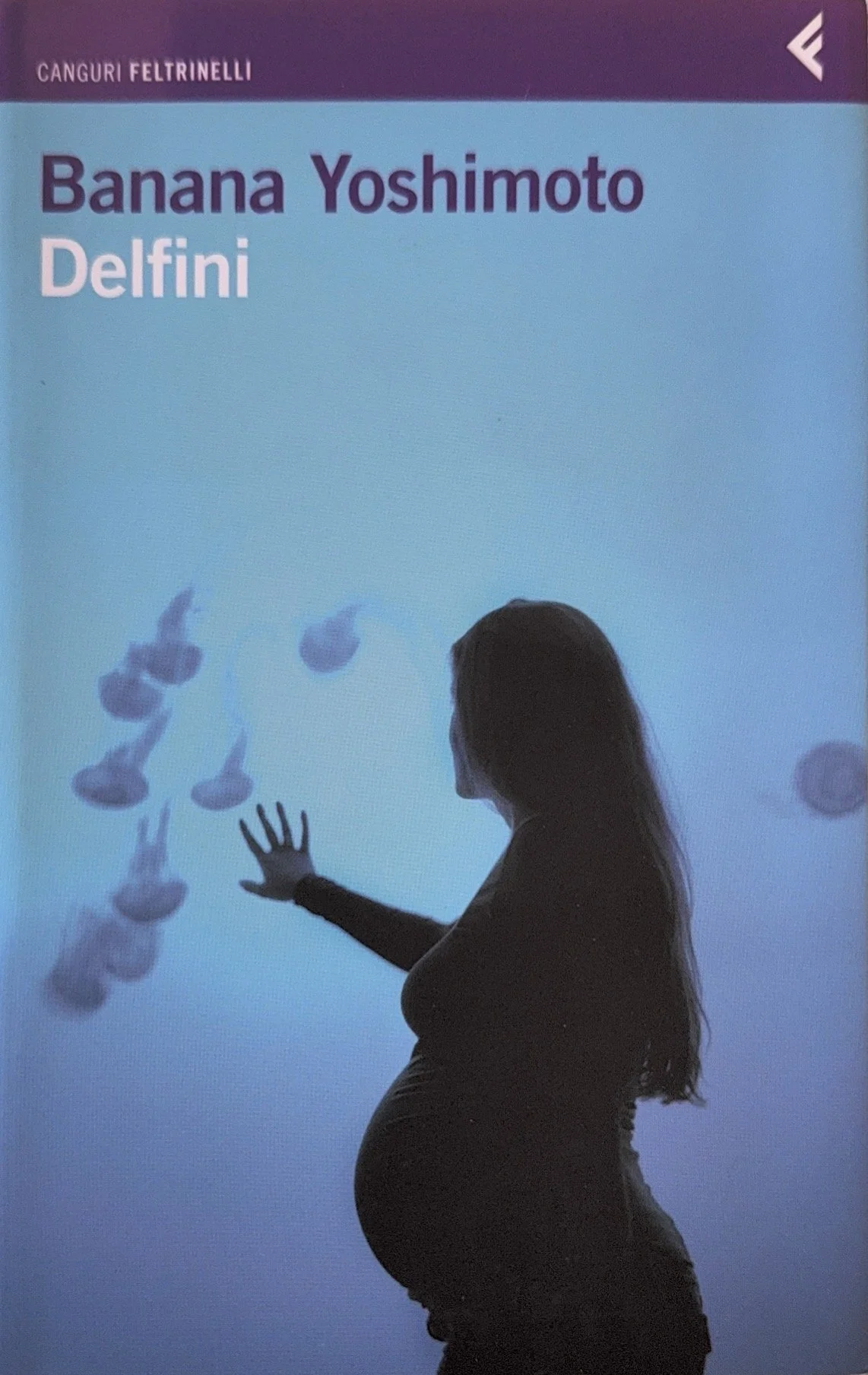
Iruka – イルカ (Italian edition “Delfini”, Feltrinelli)
Author: Banana Yoshimoto
Reviewer:: Roberto Matteucci
Click Here for Italian Version
"... men don't know the proper ways of sex. It is immediately clear how they have acquired their experience. And, contrary to popular belief, few have learned to do it with another human being.” (p. 42, author’s translation from the Italian edition, Feltrinelli)
Manga production began after World War II, in which Japan suffered a catastrophic defeat. Manga had instant success. The reason lies in the target audience: young people, children, and adolescents.
The novelty is the female readership, which has assumed a central role, becoming an indispensable market segment. Unlike in the West, where comics have historically been a male domain.
The manga publishing landscape is distinguished by its extraordinary breadth and thematic complexity; each cluster has its own genre, with references to Japanese history, such as samurai adventures, and to contemporary daily life.
Among the subjects, the theme of sex is particularly captivating. Adolescents are highly sensitive to the topic.
It is not just porn. Manga uses explicit language to address young people and their problems: those related to growth, intimacy, and social interaction.
Youths face the world totally disconnected from the surrounding reality. It is the concept of hikikomori, which originated in Japan and has created absurd figures such as 'rental older sister' (1) and 'friends for hire' (2).
A radical generational divide also emerges. They perceive adults as adversaries. Parents appear detached, inadequate in their role as guides. Alongside this, incompetent teachers are veritable 'monsters' who pose a threat to students' growth.
Furthermore, there is a linguistic and behavioural rebellion relatable to contemporary readers.
This literature has become an integral part of the commercial system.
In the 1980s, postmodern literature emerged from manga, but also from television, which shared the same characteristics. Manga, television, and literature employed the same codes of reading and the same youthful imagination. What was the social and psychological condition of the new generations in those years? Uncertain, doubtful, indifferent, disillusioned, dissatisfied, sex-obsessed or sexually liquid, but above all, erotically apathetic. With such protagonists, postmodern literature takes shape:
"If the modern novel was by definition the novel of the individual and of psychological introspection, in the postmodern novel the individual is a weakened, decentralised, multiplied, and fragmented subject." (3)
Two promising Japanese writers, following these trends, have become famous and acclaimed worldwide: Haruki Murakami (4) and Banana Yoshimoto.
Banana Yoshimoto is irreverent:
"as in the case of the young Banana Yoshimoto, irreverent towards Culture." (p. 48, author’s translation from the Italian edition, Feltrinelli)
She is irreverent, but the twenty-year-old writer is well known for her generation’s stylistic traits. She also grasps how to master the tools of the culture industry. Banana Yoshimoto states:
"We belong to the generation raised on manga and television." (p. 49, author’s translation from the Italian edition, Feltrinelli) [NOTE PER CHATGPT “Siamo della generazione allevata a manga e televisione.”]
In her book Iruka – イルカ (Italian edition “Delfini”, Feltrinelli), Banana Yoshimoto paints a disturbing portrait of Japanese human nature. It represents postmodern, minimalist literature, featuring predominantly female characters, carefree, volatile, sleepy, or drunk wandering the streets of Tokyo.
The author describes the Japanese social structure without mediation, without euphemisms.
The protagonist Kimiko is an independent and free-spirited woman, but she cannot get on with her sister. However, Kimiko must recover at home and ask her sister to look after her. It is the first step toward maturity.
Kimiko maintains a semblance of normality, yet lives an isolated and solitary existence. It is her sister, with all her differences and idiosyncrasies, who helps her.
Gorō is her boyfriend. In reality, Gorō has two girlfriends. Alongside Kimiko, he has an intense relationship with an older woman.
In today's Japan, sex, unstable liaisons, the inability to break free and build something are people's primary fears. It is an economically wealthy nation, but with a complex social order:
"... a middle class which, although it had no economic problems and even had a certain refinement, mysteriously lived in a world permeated by violence." (p. 53, author’s translation from the Italian edition, Feltrinelli)
Despite sexual freedom, Japanese relationships are fragile and evanescent.
Building a bond on these foundations is impossible, with a few exceptions.
Kimiko must travel, taking refuge in a shelter for women in need:
"They were women in difficulty because of their relationships with men, certainly not women who were finished." (p. 63, author’s translation from the Italian edition, Feltrinelli)
She confronts them until she discovers she is pregnant.
This is the moment of responsibility. Being a woman prevails, and she finally liberates herself from social burdens.
A child is costly, but it does not matter. She wants him; she has beaten an evil spirit:
"... we are always fighting against something unknown. A sort of evil spirit ... Our true enemy is ourselves, the fears of our ego." (31, author’s translation from the Italian edition, Feltrinelli)
Life is harder and more complicated in a society where being a single mother is an indelible mark. Kimiko chooses feminine freedom. She desires to triumph over so much loneliness and a precarious future.
Kimiko is the narrator. She recounts, almost dispassionately and candidly, an evocative and feminine personal story. Women, though deceived and defeated, manage to endure precisely in the face of difficulty with their moral strength.
Banana Yoshimoto amplifies the thoughts of the new generation, especially women-centred. Teenagers and women are all confined within the sprawling metropolis of Tokyo. In that environment, dramas arise, but also revenge. Young people in Japanese cities are dazed by television and manga. They are immersed in video games, consuming only junk food and listening to pop music.
All around them are insubstantial, fragmented families, with an ephemeral, mutually exclusive sexuality.
Banana Yoshimoto captures her milieu well and is able to narrate it with a pervasive melancholy that reflects the condition of the contemporary Japanese generation.
“There is a new profession in Japan created for young hikikomori, called 'rental older sister.' This young woman has no particular professional training, but uses her empathic abilities as a working tool. She focuses her care on those hikikomori who have been in seclusion for a relatively short time, at most a year. It is the hikikomori's mother who contacts the rental older sister ... This rental older sister attempts to establish communication with the hikikomori by slipping messages on pieces of paper under the hikikomori's room door.” (Giulia Sagliocco edited by, Hikikomori e adolescenza. Fenomenologia dell'autoreclusione, Mimesis, Milan, 2011, author’s translation)
Roberto Matteucci, “In cerca di un amico Regista: Karma Gava e Alvise Morato” December 5, 2016, https://popcinema.org/film/in-cerca-di-un-amico-di-karma-gava-e-alvise-morato, (accessed March 16, 2026)
Luisa Bienati, ed., Letteratura giapponese volume II Dalla fine dell'Ottocento all'inizio del terzo millennio, Einaudi, Torino, 2005, p. 50, (author’s translation)
Roberto Matteucci, “Kafka sulla spiaggia di Murakami Haruki” December 2, 2016, https://popcinema.org/libri/kafka-sulla-spiaggia-di-murakami-haruki, (accessed March 16, 2026)
Webography:
Roberto Matteucci, “Il manga. Storia e universi del fumetto giapponese - Jean di Marie Bouissou” March 15, 2013, https://www.sololibri.net/Il-manga-Storia-e-universi-del.html, (accessed March 16, 2026)
Roberto Matteucci, “Il corpo sa tutto di Banana Yoshimoto” October 25, 2016,
https://popcinema.org/libri/il-corpo-sa-tutto-di-banana-yoshimoto, (accessed March 16, 2026)
Roberto Matteucci, “Il coperchio del mare di Banana Yoshimoto” October 18, 2016,
https://popcinema.org/libri/il-coperchio-del-mare-di-banana-yoshimoto, (accessed March 16, 2026)


An in-depth analysis of Banana Yoshimoto’s Iruka: a portrait of a fragmented Japanese generation, exploring manga codes, hikikomori, and metropolitan loneliness.