Simone Cantarini (1612–1648). A Young Master between Pesaro, Bologna, and Rome

Simone Cantarini (1612–1648). A Young Master between Pesaro, Bologna, and Rome
Urbino, Palazzo Ducale
Piazza Rinascimento
22 February to 29 June 2025
Curated by Luigi Gallo, Anna Maria Ambrosini Massari, and Yuri Primarosa
Author: Roberto Matteucci
Image credit: popcinema.org
Click Here for Italian Version
Simone Cantarini, known as Il Pesarese, was born in Pesaro in 1612 and died in Verona in 1648. He was only thirty-six years old. One hundred and twenty-eight years earlier, Raphael Sanzio died on his thirty-seventh birthday.
Both Cantarini and Raphael also share a ‘venticello’ regarding the cause of their deaths: poisoning.
Simone Cantarini:
"... «gradually passed away from a slow but continuous dysentery» with the almost certain symptomatology of ongoing poisoning. Death occurred on 11 October 1648 ... It is therefore not unreasonable to believe that Simone and Zoppo were poisoned by a rival during lunch, and while Zoppo died almost immediately, Il Pesarese managed to drag himself laboriously to Verona." (1) (Author’s translation)
Among the many hypotheses about Raphael’s death, some sources speak of poisoning by rivals:
“Later historical sources hypothesize the sudden death of the young genius resulted from poisoning. The hypothesis, which can help to better contextualize Raphael’s death, probably originated in a satire, composed in Rome around 1712, telling of a spectacular exhumation of Raphael’s extraordinarily well-preserved remains. The integrity of the corpse suggests the presence of arsenic as a preservative, a substance that was used until the 19th century by famous embalmers. Arsenic poisoning by a rival was also proposed; however, no available historical source authorizes such a supposition.” (2)
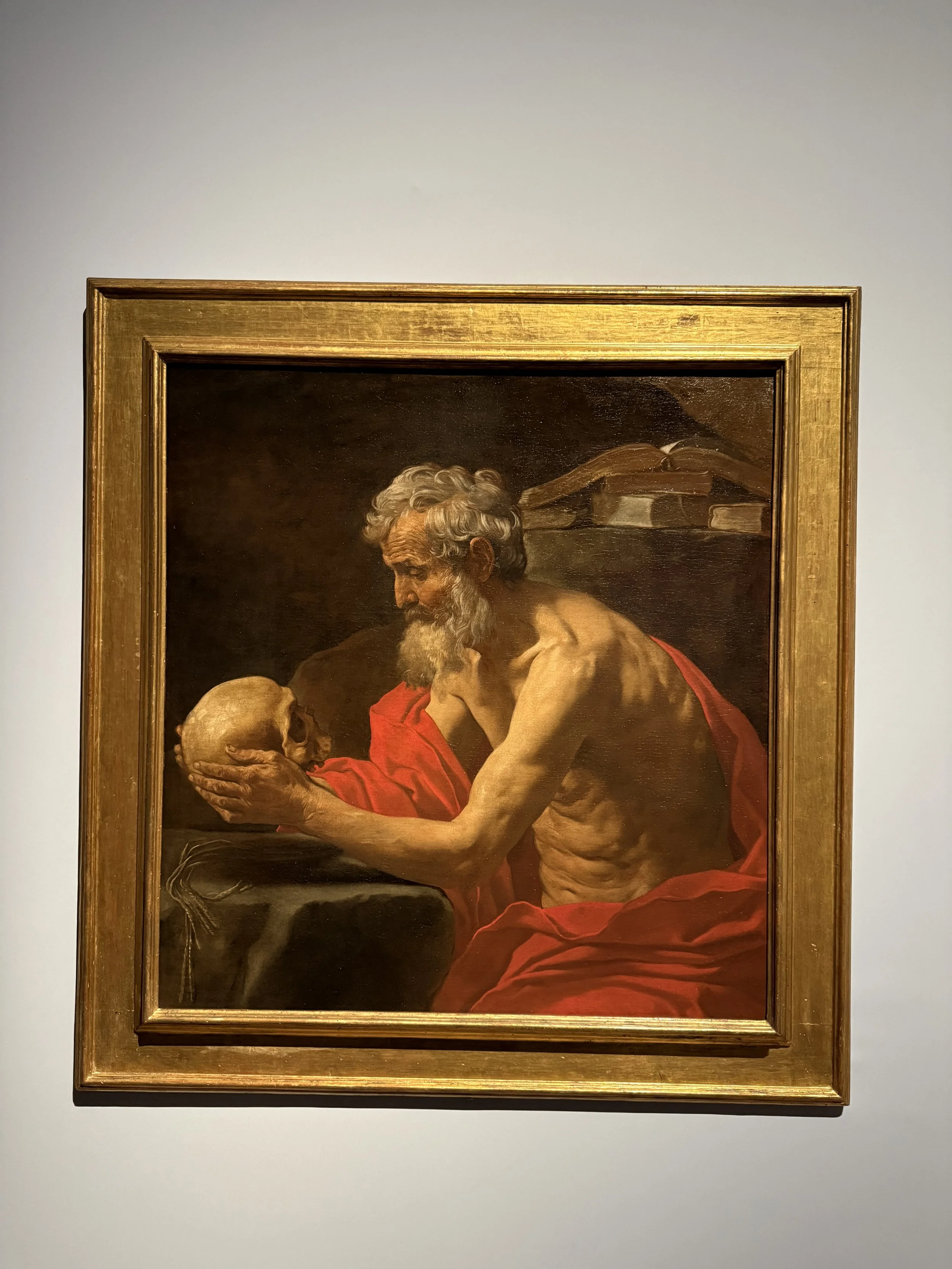
Simone Cantarini, San Girolamo in meditazione, Saint Jerome in meditation
The coincidence of their age and the morbid curiosity surrounding the causes of death are pure literature, nothing real — a game for art historians and novelists.
Something else unites these two figures from the Marche region: the province and the cultural and intellectual context. A small provincial environment, a green territory, a minuscule reality, yet only in appearance. In truth, it is a habitat rich in art, artists, artisans, and schools of thought, all of which generate vitality and creativity. A forge of painters, talents, and thinkers that emerged within a confined space:
“Is it a provincial history? If so, then the whole of Italy is one vast, dense province of schools and workshops, of artists and formidable creative intelligences, of cultured artisans and learned professionals, who live and work within a landscape articulated far more intensely than it appears today. Villages and small towns, hamlets and castles still exhibit their colourful vitality within the framework of a struggle for survival. This history frames them in a very particular moment: that is, at the beginning of the 17th century and the Baroque age, or, if one prefers, during the slow extinguishing of that Renaissance fire which, even during Mannerism, marked cities and countryside with glows and apparitions, thanks to famous and now empty palaces—such as that of Federico da Montefeltro in Urbino—and a great number of military fortresses, formidable architectural inventions where the personality of Francesco di Giorgio Martini was expressed.” (3) (Author’s translation)
The exhibition “Simone Cantarini (1612–1648). A Young Master between Pesaro, Bologna, and Rome” will be held from 22 February to 29 June 2025 at Palazzo Ducale in Urbino, a masterpiece completed by Francesco di Giorgio Martini.
This is the second retrospective on Cantarini in recent times. The previous one was held in Pesaro in 1997: “Simone Cantarini in the Marche”. The common thread is the Marche region, where he was born and from which he set out on a journey:
"The narrative, in fact, has a beginning which, not coincidentally, we can imagine... descending from the Furlo Gorge, the ancient Roman pass that leads the Via Flaminia to the banks of the Metauro, to Fossombrone and Fano; and from there, ascends the Siligate and descends again towards Cattolica, reaching Rimini to enter Via Emilia and finding at least a temporary conclusion amongst the palaces and houses, or the great churches, of papal Bologna. Indeed, right in front of the seat of the legate in Piazza Maggiore, from the height of that palace, said to be the Palazzo dei Banchi, newly built, where Guido Reni, the painter acclaimed throughout Europe, had opened his studio. A series of spacious rooms accessed from the market on Via Pescherie, where the master worked and lived out his harsh, increasingly tormented days." (4) (Author’s translation)
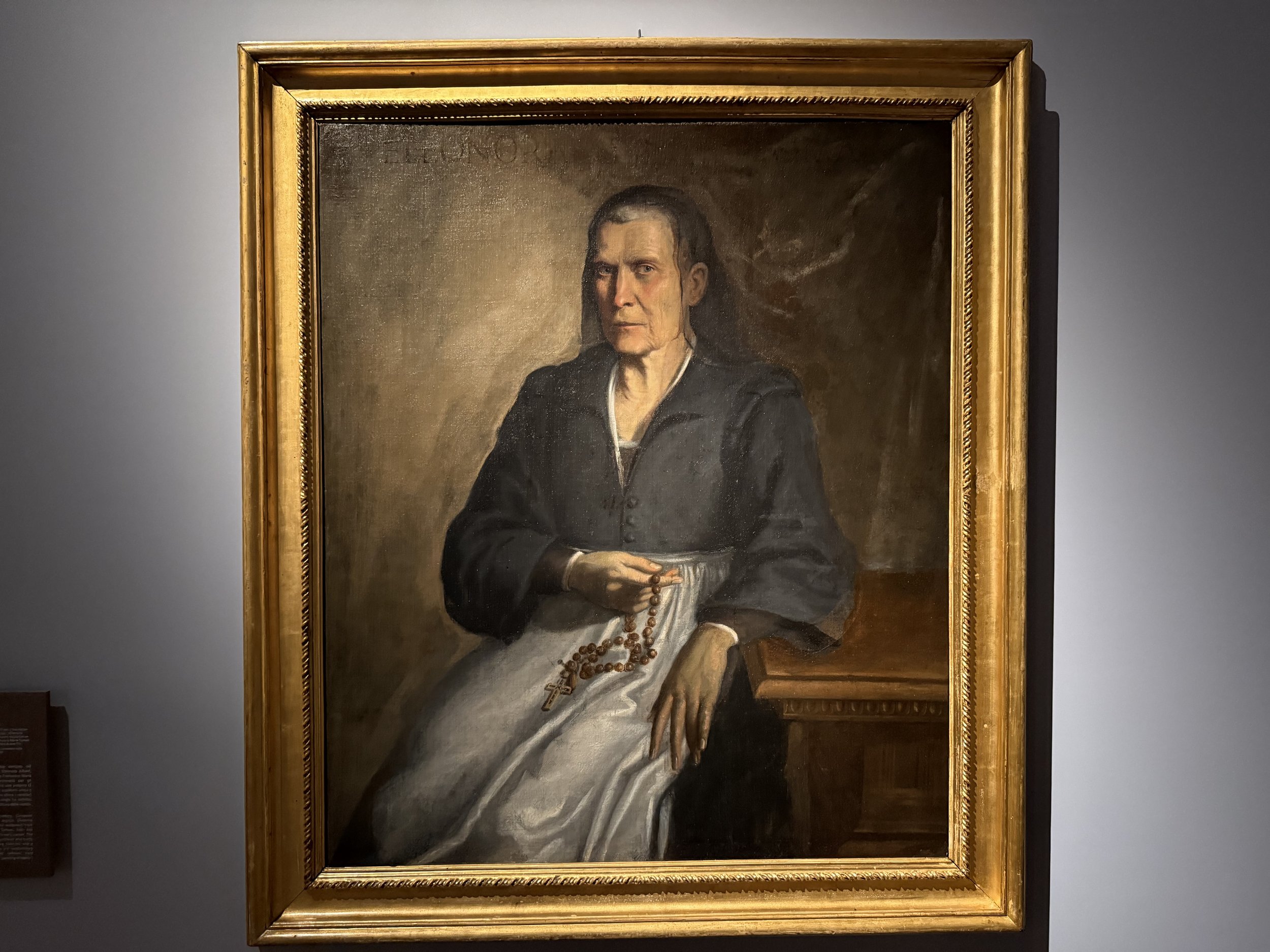
Simone Cantarini, Ritratto di Eleonora Albani Tomasi, 1635-1638
This is the compelling narrative odyssey of the Pesarese. The 2025 exhibition was born from a journey: a fascinating, evocative itinerary through hills, gorges, rivers, the sea, palaces, houses, and churches. It begins in Pesaro, in the Duchy of Urbino, and culminates in Piazza Maggiore in Bologna, in Guido Reni's atelier.
From the province to the city. Cantarini's legacy was his love of painting. Simone had already studied under prestigious masters such as Giovanni Giacomo Pandolfi and Claudio Ridolfi.
Another artist who might be considered his mentor is Federico Barocci. He died in Urbino in the year Simone Cantarini was born, yet his work influenced and enriched the young Cantarini:
"... the Pesarese developed an extraordinarily innovative language, the result of his training in the Marche region under the sign of Raphael and Barocci, combined with the model of Reni that he studied in Bologna between 1630 and 1639, and the study of the antique to which he had dedicated himself during the two-year period in Rome, framed within the Barberini team. (1640-1642)" (5) (Author’s translation)
After centuries, some of Cantarini's works have come back thanks to the "100 works return home" initiative. Through this project, the Ministry of Culture arranged the 2021 repatriation of one hundred paintings from museum storerooms to various venues, ensuring them greater visibility. Among these were the “Madonna and Child in Glory with Saints Barbara and Terence” as well as the “Child Jesus appears to Saint Anthony of Padua”, by Simone Cantarini, transferred from the deposits of the Brera Art Gallery to the National Gallery of the Marche in Urbino. (6)
According to the organisers, the availability of other pieces by the artist is the reason behind the exhibition, marking a homecoming to his land of origin:
"The first of its kind in Urbino, a city frequented by the young Cantarini, the exhibition is also an opportunity to celebrate the entry of the Pesarese artist's works into the Palazzo Ducale collections. Following the deposit of the collection from the Fondazione Cassa di Risparmio di Pesaro and the arrival of two large altarpieces from the Pinacoteca di Brera as part of the 100 Works Return Home project, the exhibition has been enriched with a further group of works, thanks to the loan agreement signed with Intesa Sanpaolo, which also includes five paintings by Cantarini." (7) (Author’s translation)
For a critical reading of the exposition, it is fundamental to situate Cantarini within the places and spaces of his birth and formative years.
The curators are Luigi Gallo, director of the Galleria Nazionale delle Marche, Anna Maria Ambrosini Massari, professor of History of Modern Art at the University of Urbino Carlo Bo, and Yuri Primarosa, official art historian at the Ministry of Culture.
Luigi Gallo and Anna Maria Ambrosini Massari have already worked together on the 2024 exhibition "FEDERICO BAROCCI URBINO. The emotion of modern painting”. The work on Barocci is the fundamental starting point, and the study of Simone Cantarini is the natural progression.
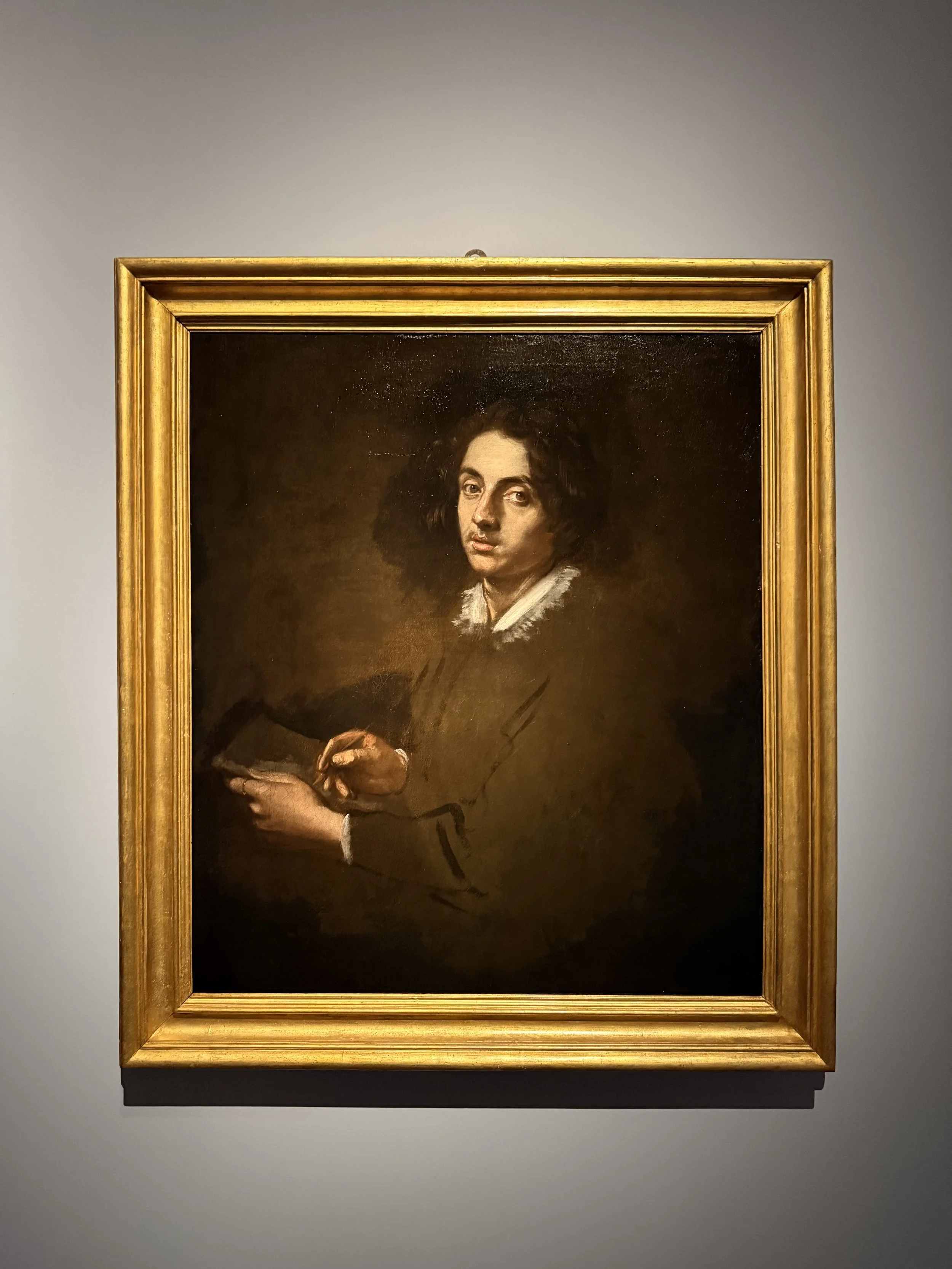
Simone Cantarini, Autoritratto con taccuino e lapis, Self-Portrait with notebook and pencil
The exposition has been staged inside the sublime masterpiece of architects Luciano Laurana and Francesco di Giorgio Martini: the Ducal Palace of Urbino. Not in the noble and sumptuous galleries of the upper floors, but on the ground floor, where daily activities originally took place. This atmosphere is better suited to intimate exhibitions, than to displaying major masterpieces by prestigious artists. The same happened for the 2024 Barocci retrospective.
The curatorial path is thematic. A thoughtful itinerary to highlight Cantarini's finest work, both from a pictorial perspective and in terms of his character: a vigorous, impatient, restless temperament. The monograph Simone Cantarini il Pesarese depicts him in this way:
“Possessing a self-centred, rebellious, and proud character, and being forced into tightrope-walking acts in an oppressive atmosphere of slander, professional jealousies, and malicious criticism; to nourish a poignant yearning for the clear, azure spaces that stretched beyond the paternal fields on Monte Accio, now the sunny hill of San Bartolo in the Pesaro area, and feeling suffocated by the academic rigour of scholarly Bologna seeking fleeting contact with humble and modest people, yet having to constantly frequent the loftiest lay and ecclesiastical nobility of the age; sensing the genuine power of his art and frequently seeing his brilliant works being smuggled as Reni's creations: all of this is evident in Simone Cantarini: the torment of a man and an artist, tragically cut short at the height of an exuberant activity at the age of thirty-six.” (8) (Author’s translation)
Guido Reni, his Bolognese master, also knew something about this volatile personality. The opening artistic bond between the two painters soon turned into a fight. Cantarini was at first respectful and humble, becoming a highly-regarded pupil. However, due to his "self-centred, rebellious, and proud character" (8), he began to resent power, even criticising his own mentor. For this reason, he was forced to leave Bologna and seek refuge with the Duke of Mantua. His relationship with the Duke also deteriorated, provoking the nobleman's wrath. Luigi Lanzi, an 18th-century art critic, describes him openly in his writings on artists from Emilia and the Marche region:
"In order to resemble the Prototype more closely, Simone went to Bologna and became Guido's disciple, initially affecting humility and deference, and artfully concealing his mastery. Then, gradually revealing it, he came to be held in the highest esteem by the Master … Soon he became vain in his talent, and began to criticise not only the mediocre, but Domenichino, and Albano, and Guido himself. In the copies that the pupils made of the Master's paintings, he boldly applied his hand, correcting now one oversight, now another in the copy; and finally he began to openly criticise Guido, and to provoke his resentment. Due to such arrogance, and his negligence in fulfilling commissions, he fell into public disrespect, and left Bologna for some time; and remained in Rome almost as a fugitive, studying Raphael and ancient marbles: he then returned and taught in Bologna, where he also went to serve the Duke of Mantua. But whatever change of country he made, he was always accompanied by his ill-temper; a great admirer of himself, contemptuous of all others, to the point of mockingly deriding Giulio and Raffael d'Urbino: so that, to the extent that his works were pleasing, so much the more his person was hated. Having also incurred the Duke’s wrath, and having failed in portraying him, he was so mortified that he fell ill from grief; and having gone to Verona, he died there shortly after, at the age of thirty-six, in 1648, and not without suspicion of poisoning”. (9) (Author’s translation)
The three main characteristics that emerge from Cantarini's survey are his homeland, his strong and turbulent disposition, and Guido Reni. The exhibition also features Cantarini's portrait of his master.
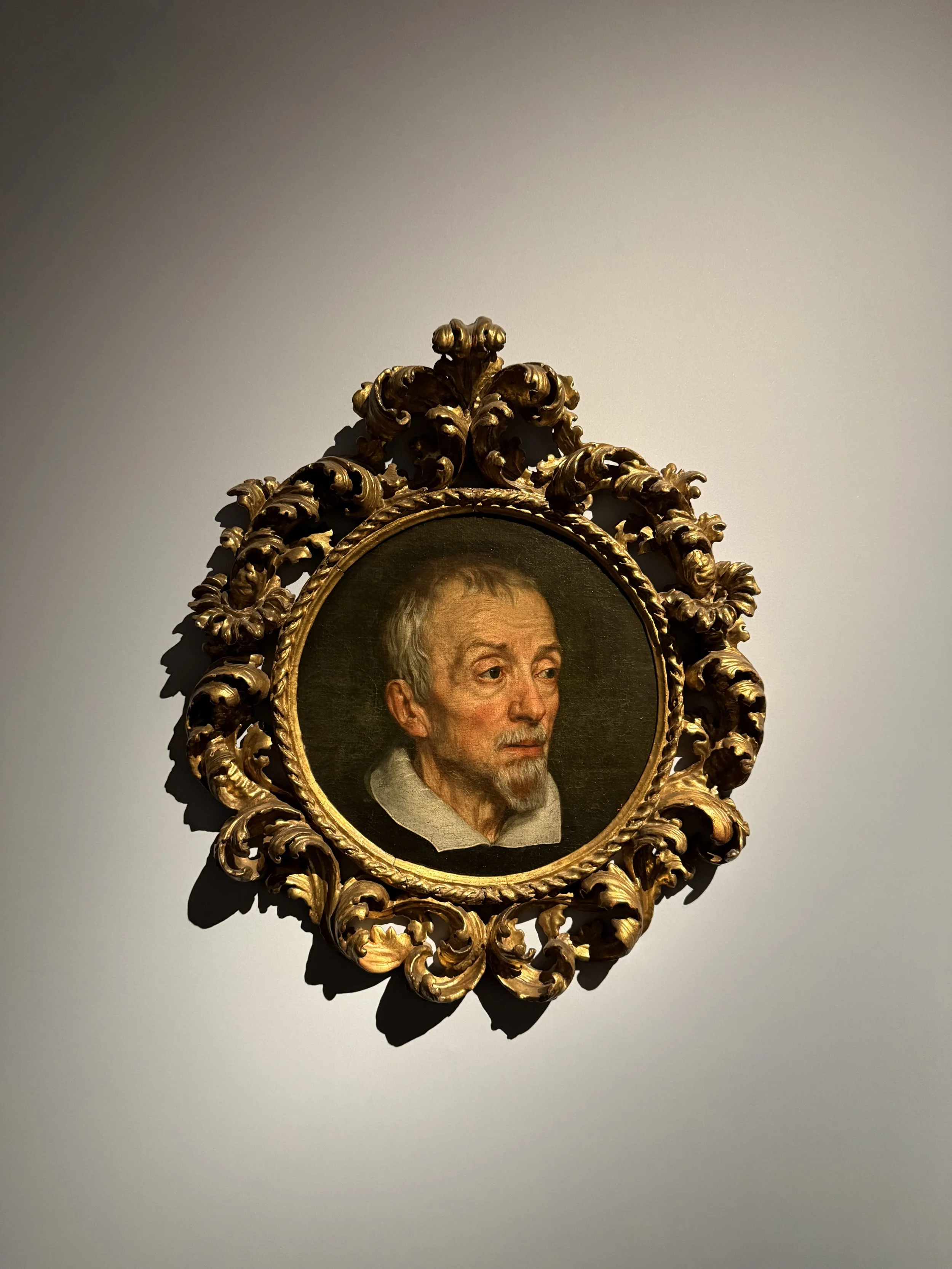
Simone Cantarini, Portrait of Guido Reni
1637, National Gallery of Bologna
The journey to Bologna was crucial for his cultural education. It led to his meeting with Guido Reni, who was by then extremely famous and influential. Guido Reni was wealthy and had many commissions; he was "a man devoted to his work and tormented by his own rigour, yet also irascible and impulsive." (10)
Unfortunately, as already noted, Cantarini was also hot-tempered. Consequently, their relationship became stormy over time, leading to arguments and brawls in the streets of Bologna:
"The apprenticeship with Reni was fundamental in refining his technique and developing a pictorial language of great elegance, but the relationship between the two proved difficult. Cantarini, with a proud temperament and little inclination to submission, manifested a desire to emancipate himself from the master's influence, openly criticising his work and creating a more personal and dynamic pictorial language. The rift with Reni became inevitable, and after leaving the Bolognese workshop, Cantarini embarked on an independent career, consolidating his own style and attracting the attention of important patrons." (11) (Author’s translation)
Despite the clashes, Cantarini learned much from Guido Reni: elegance, technique, grace, and the rendering of faces.
Cantarini's portrait is also an act of respect. Guido Reni is an elderly man, enfeebled but with a still active expression. Is he looking out of the frame, perhaps towards Cantarini? The painter does not hide but rather lightens the signs of ageing. The wrinkles, the thinning white hair, the evident baldness, and the bags under his eyes are natural and realistic, yet they do not distort his individuality; it is simply old age. The pose inspires authority and the awareness of a remarkable and rewarding career. The tondo has a basic black colour, matching the garment of the same tone. The white collar stands out. The external light source strikes the face until it illuminates it, and this glow enhances Reni's features.
Madonna and Child in Glory with Saints Barbara and Terence
1630-1632, Galleria Nazionale delle Marche di Urbino, on loan from the Pinacoteca di Brera di Milano
The upper section is dominated by the presence of a beautiful, young, and gentle Madonna. She is seated on a cloud whilst holding an infant Jesus, also on the same cloud but standing. The Madonna's gaze is directed downward, turned to the earth, observing her devoted saints. Around her, a multitude of angels, playing music, sing their hymns of praise.
Below, on the ground, are two saints, two early Christian martyrs, but portrayed in different poses.
Saint Terence, the patron saint of Pesaro, looks toward the sky. He has an ecstatic expression and seems to meet Jesus’ gaze. Saint Terence has his right hand on his chest, while his left hand holds a flag. The flag, rendered in perspective, reaches upward and rises above the clouds. Saint Terence wears a warrior's tunic. His posture is elegant, his right foot is forward, and his legs are anatomically defined, half-covered by his footwear. His feet are imposing, majestic, and powerful, with long toes and a commanding big toe. In this regard, one might recall Gadda's famous description of his feet:
“The little strap of a shoe that was otherwise unperceived segregated and individualised the knobby one in that august pre-eminence which is peculiar to it, that is the big toe’s, and the big toe’s alone, branching it off from the throng of lesser-ranked little toes.” (12) (Author’s translation)
His blond hair matches the yellow of his cloak, which majestically drapes over his neck and covers his back, reaching down to the ground. Its folds convey a refined sense of undulating movement. Overall, he is an emotional and religious figure. He is an early Christian saint who died for his faith, likely in 251 AD. (13)
An ancient, mythical presence, a symbol of intense religiosity. Within him lies a conviction beyond question; on the contrary, it kindles hope even after death. A melancholic saint: “The melancholic attitude of Saint Terence.” (14) (Author’s translation)
On the other side is another famous primitive Christian martyr: Saint Barbara. Cantarini depicts her as the patron saint of artillerymen and armourers. In her right hand, she holds the palm of martyrdom, while simultaneously resting her arm on a small cannon. Her right foot rests on a barrel of gunpowder. The saint's other more classic attributes, such as the tower, sword, and lightning bolt, are absent. She is, therefore, a deliberately military saint. Indeed, her gaze is not dreamy, like that of Saint Terence, since Saint Barbara looks out of the painting downward. Her face is serene yet strong-willed. Her black and white dress is partially covered by a large red cloak that wraps around her body to her shoulders, but, unlike that of Saint Terence, sweeps toward the sky. The very gesture of her left arm, with one finger pointing at the Virgin Mary, is a reminder of her immortal faith.
On the whole, the attitude of the figures is more symbolic than literal.
The composition stands as a testament to an ardent piety and to the artist’s deep devotion to his birthplace, Pesaro.
The composition is triangular, with the saints depicted full-length at the base and the Madonna at the top. In the centre, a city is visible in perspective—perhaps Pesaro? The colours are bold, and the light source is verisimilar, coming from a cloudy sky.
Pesaro is present both through its patron saint and because the painting was commissioned for the Church of San Cassiano, where Cantarini was baptised on 21 August 1612. The masterpiece was subsequently requisitioned from the church in Pesaro by Napoleon’s army and relocated to Milan. It was later placed in the Brera Museum storerooms, and then last year, the work finally returned, not quite home, but very close. Thus, Cantarini’s homeward journey can be deemed complete.
The curators, especially Professor Anna Maria Ambrosini Massari, are renowned experts on Simone Cantarini, so this exhibition perfectly achieves its purpose. It is also a celebration of the return from an imaginary and real voyage along the Adriatic Sea, following the Via Emilia to Bologna, and then reaching Milan, all due to Napoleon.
The exhibition allows visitors to observe the various phases of the artist's life. It is possible to compare some works on the same subjects, such as those dedicated to Saint Jerome. The focus is on the importance of draughtsmanship and colours that are never exaggerated.
The organisers have highlighted the most significant aspect of the exhibition: the love for Simone Cantarini, known as 'Il Pesarese', and for his province, steeped in art, culture, and beauty.
Mario Mancigotti, Simone Cantarini il Pesarese, with an introduction by Marco Valsecchi, Pesaro, Banca Popolare Pesarese, 1975, p. 57
“Commentary on Raphael’s The Transfiguration”, October 2023, Academic Medicine, https://academic.oup.com/academicmedicine/article/98/10/1141/8344836 (last accessed 2 March 2026)
Andrea Emiliani, “Simone Cantarini. La coscienza dell'artista moderno”, in Simone Cantarini nelle Marche, edited by Andrea Emiliani, Anna Maria Ambrosini Massari, Marina Cellini, and Raffaella Morselli, Venice, Marsilio, 1997, pp. XXI-XXII
Andrea Emiliani, “Simone Cantarini. La coscienza dell'artista moderno”, in Simone Cantarini nelle Marche, edited by Andrea Emiliani, Anna Maria Ambrosini Massari, Marina Cellini and Raffaella Morselli, Venice, Marsilio, 1997, pp. XXI
“Simone Cantarini (1612-1648). Un giovane maestro tra Pesaro, Bologna e Roma”, Galleria Nazionale delle Marche, https://gndm.it/simone-cantarini-1612-1648-un-giovane-maestro-tra-pesaro-bologna-e-roma/ (last accessed 2 March 2026)
Roberto Matteucci, “The Other Collection: Stories and Works from the Deposits of the Galleria Nazionale delle Marche”, popcinema, https://popcinema.org/arte-cultura/laltra-collezione (last accessed 3 March 2026)
“Simone Cantarini (1612-1648). Un giovane maestro tra Pesaro, Bologna e Roma”, Galleria Nazionale delle Marche,https://gndm.it/simone-cantarini-1612-1648-un-giovane-maestro-tra-pesaro-bologna-e-roma/ (last accessed 2 March 2026)
Mario Mancigotti, Simone Cantarini il Pesarese, with an introduction by Marco Valsecchi, Pesaro, Banca Popolare Pesarese, 1975, p. 33
Luigi Lanzi, Storia pittorica della Italia dell'ab. Luigi Lanzi antiquario della R. corte di Toscana, tomo secondo, parte seconda: Ove si descrivono altre scuole della Italia superiore, la Bolognese, la Ferrarese, e quelle di Genova e del Piemonte, Bassano, a spese Remondini di Venezia, 1795-1796, pp. 116-117 (Retrieved from Google Books: https://www.google.it/books/edition/Storia_pittorica_della_Italia_dell_ab_Lu/3ij5Ef5AbUQC?hl=it&gbpv=1&dq=Luigi+Lanzi+Storia+pittorica+della+Italia&printsec=frontcover)
Luana De Micco, “Guido Reni impulsivo, collerico e con il vizio del gioco”, 29 November 2024, Il Giornale dell'Arte, https://www.ilgiornaledellarte.com/Mostre/Guido-Reni-impulsivo-collerico-e-con-il-vizio-del-gioco (last accessed 3 March 2026)
Redazione, “Urbino, a major exhibition on Simone Cantarini at the Galleria Nazionale delle Marche”, 28 May 2025, Finestre sull'Arte, https://www.finestresullarte.info/en/exhibitions/urbino-a-major-exhibition-on-simone-cantarini-at-the-galleria-nazionale-delle-marche (last accessed 3 March 2026)
Carlo Emilio Gadda, Quer pasticciaccio brutto de via Merulana, Garzanti, Milan, “Gli elefanti” series, Fourteenth edition, January 2000, First reprint, September 2000, p. 184
“San Terenzio Vescovo e martire”, 18 February 2005, Santi e Beati, https://www.santiebeati.it/dettaglio/92249 (last accessed 3 March 2026)
Anna Maria Ambrosini Massari, description of the painting Madonna and Child in Glory with Saints Barbara and Terence, in Simone Cantarini nelle Marche, edited by Andrea Emiliani, Anna Maria Ambrosini Massari, Marina Cellini, and Raffaella Morselli, Venice, Marsilio, 1997, p. 79
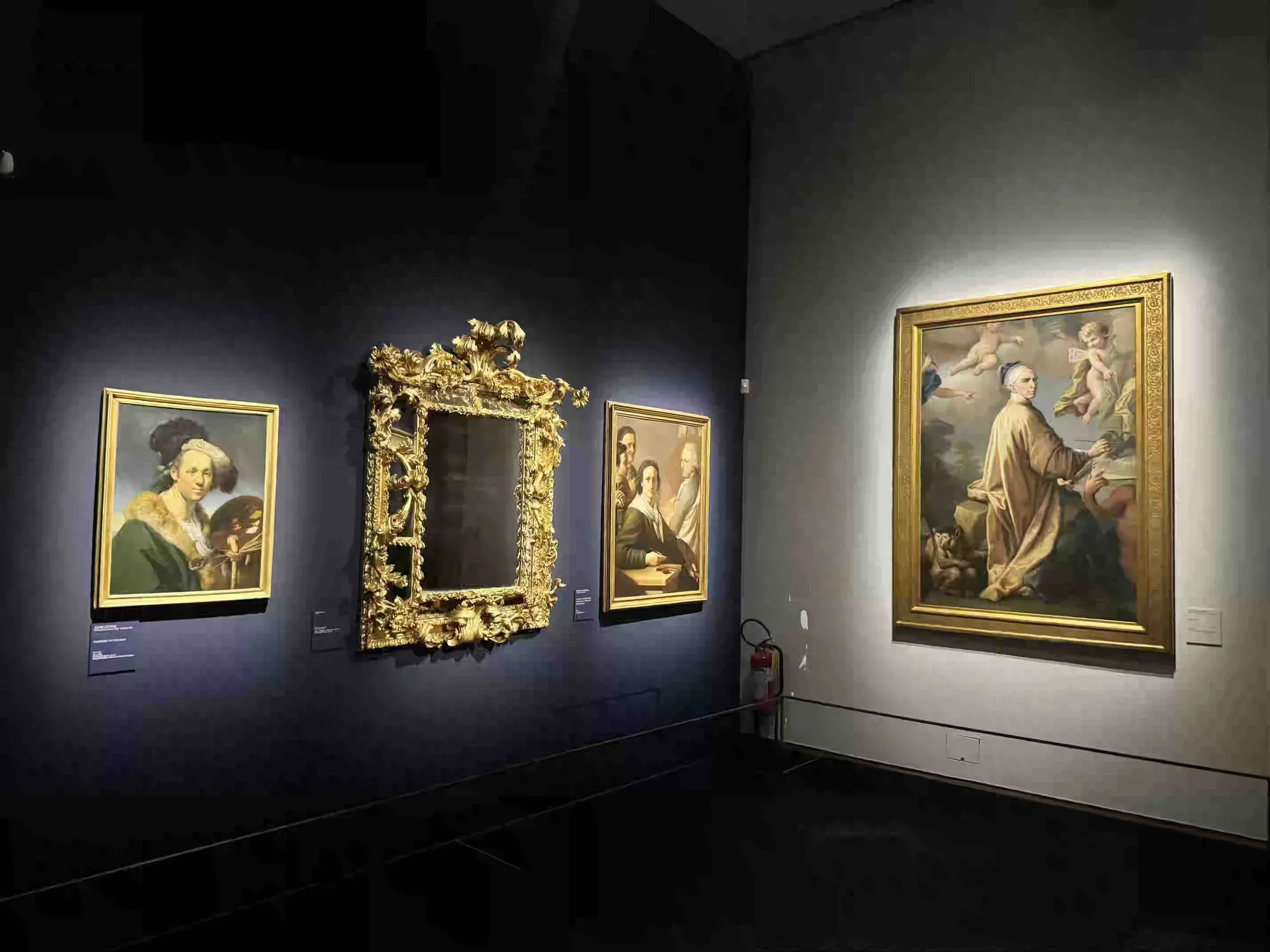




Exhibition in Urbino on Simone Cantarini (1612–1648), a young master from the Marche region between Pesaro, Bologna and Rome.